Shared with the educators who participated in the Measuring Student Agency Conditions study and with the broader practitioner and research community as a translation of the dissertation's findings via the National Center for Student Agency.
What this brief covers, at a glance.
- The dissertation study developed three new instructor-facing scales for measuring the conditions that enable student agency in real classrooms.
- Finding 1: Instructor receptivity to student agency is the strongest predictor of how much agency opportunity instructors actually extend to students—in K–12 and higher education alike.
- Finding 2: For K–12, the amount of authority instructors have over course decisions is also a substantial predictor of how much agency they extend to students. In higher education, where instructors typically have greater discretion, this relationship vanishes.
- Together, the three scales let educators, leaders, and researchers see why agency might be missing in a given course—and therefore what kind of support might actually help.
- Next steps for research: student-facing scales (in development), pairing with classroom observation, and replication beyond the original sample.
Why this study, why now?
For many students, school today is a place where doing well means complying. Curiosity, dissent, and self-direction are tolerated in proportion to how compatible they are with the structures the adults have already chosen—what is studied, when, in what format, with what assessment. Behind that pattern is a set of conditions in classrooms and institutions: who is allowed to make which decisions, whose ideas get to shape the work, what counts as evidence of learning. The conditions matter for what young people get out of school, and they vary in ways the field has not yet done a comprehensive job of measuring.
Student motivation is an ongoing challenge in many U.S. middle-grades classrooms and across higher education. Career exploration, identity formation, and self-advocacy are happening with or without intentional support, and the quality of that support is distributed inequitably. The field of education has many measures of individual student psychology—engagement, motivation, growth mindset, self-regulation, self-efficacy, and satisfaction with school. What it has not had are measures of the conditions that enable student agency at the course level: instruments that surface what instructors actually offer students in terms of control over learning, what instructors hold as values about doing so, and what instructors are allowed by their schools and systems to extend in the first place. My dissertation, Measuring Student Agency Conditions (Harvard University, May 2026), was designed to fill that gap.
What is student agency?
Student agency is the extent to which students have the capacity to exercise control over the nature and quality of their school learning—and, by extension, over their development as the kinds of people they want to become through learning. Research connects student agency, to varying degrees, with motivation to learn, a sense of purpose in learning, personal ownership of and responsibility for one's learning, willingness to take initiative, confidence in one's ability to learn, and a deeper appreciation for learning itself. A student with high agency, observable in their daily life at school, wants to make choices about their learning, knows how to make those choices, actually makes them, follows through on them, and learns from the consequences—including the mistakes.
I believe that agency is not a luxury good. It is not something to be earned by already-engaged students after they have proven they can comply. It is a baseline condition of meaningful learning that adults either extend to young people or withhold from them. Designing schooling so that all students—especially those whose voices the institution of education has historically not made room for—can develop and exercise their agency is, in my view, one of the central challenges of this moment in education. Doing so will involve policy shifts and educators being afforded the capacity to provide intentional 1:1 support, guidance, and what I call "caring accountability" regarding students' decision-making about their own education.
What did the items measure?
Along with demographic and contextual items, the survey measured three things about student agency, each through a new instructor-facing scale:
- Opportunity Provision—how much instructors report actively providing students with agency-related opportunities in a specific course (their focal course) for both curriculum and instruction. This is the headline construct: what is actually being extended to students in the classroom right now. (Short form: 12 items, drawn from a 20-item pool. Internal name: ELIPSA—Extent of Lead Instructor Provision of Student Agency.)
- Decision Latitude—how much control instructors themselves have to make agency-related decisions about the focal course (pacing, assessments, grading, required resources, required technology, in-class vs. out-of-class time, alternate-work approvals). This is the instructor's own decision space: the structural ceiling of their agency in extending agency opportunity to students. (7 items. Internal name: IARDL—Instructor Agency-Related Decision Latitude.)
- Receptivity—how open and receptive instructors are to providing students with agency opportunities for both curriculum and instruction under hypothetically favorable conditions (time, training, support, lower stakes). This is intended to isolate the instructor's values from feasibility concerns. (Short forms: 14 and 17 items, drawn from a 23-item pool. Internal name: GIRSA—General Instructor Receptivity to Student Agency.)
Each scale was developed after a review of social cognitive theory as well as related research (self-determination theory, autonomy-support pedagogy, classroom-climate research, organizational psychology, and prior measurement in K–12 and higher education).
To refine the items before the survey, I conducted cognitive interviews with educators, focus groups with instructors and experts, and consultation with a sub-group of students whose participatory action research on sex-education curricula helped to catalyze my interest in the structural conditions of agency.
How the three constructs connect
I hypothesized that instructors' provision of agency opportunity to students is influenced by their general attitudes (receptivity) to its provision and by their own agency opportunity (decision latitude) regarding student-agency-related course decisions.
Who participated and how the study was done
Through a survey, I collected complete responses from 797 lead instructors—that is, instructors who could speak to the design and conduct of a specific course they had recently led. The sample was distributed across U.S. K–12 and higher education and was recruited via the Prolific research platform in September 2025. Demographic distributions on age, sex, and race approximated U.S. averages.
The methods are very technical in places—fuller treatment is in the dissertation itself—but in plain language: I evaluated each scale's psychometric properties to determine if and how consistently the items behaved and if and how well the scales meaningfully distinguished between instructors. I then modeled the relationships among the three conditions: how Receptivity, Decision Latitude, and other contextual factors predict Opportunity Provision, along with how those relationships compare and contrast between K–12 and higher education.
What I found
Descriptive statistics
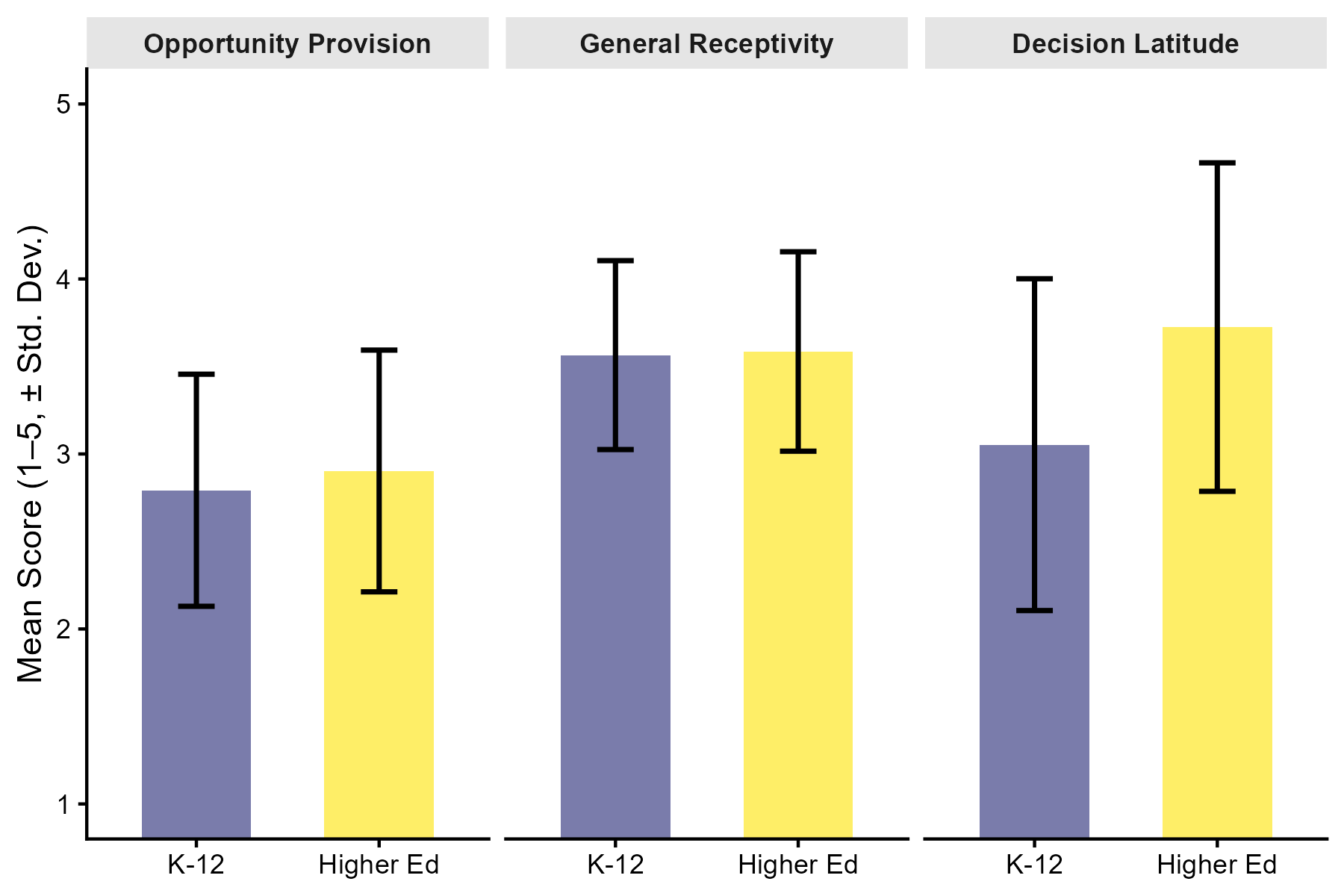
Descriptive statistics tell us the general trends within and between K–12 and higher education. The average K–12 and higher educators report providing agency opportunity to their students below the middle of the 1–5 scale, with higher educators reporting significantly more than K–12. On average, both K–12 and higher educators report moderately high receptivity to providing students with agency opportunity under hypothetically favorable conditions, with no significant difference between the sectors. K–12 teachers tend to report having much lower levels of student-agency-related decision latitude than higher education instructors. Both sectors have relatively wide variation in their decision latitude. See Figure 2 below.
Concerning the hypotheses in Figure 1 about how the measures relate to each other, two findings are worth foregrounding:
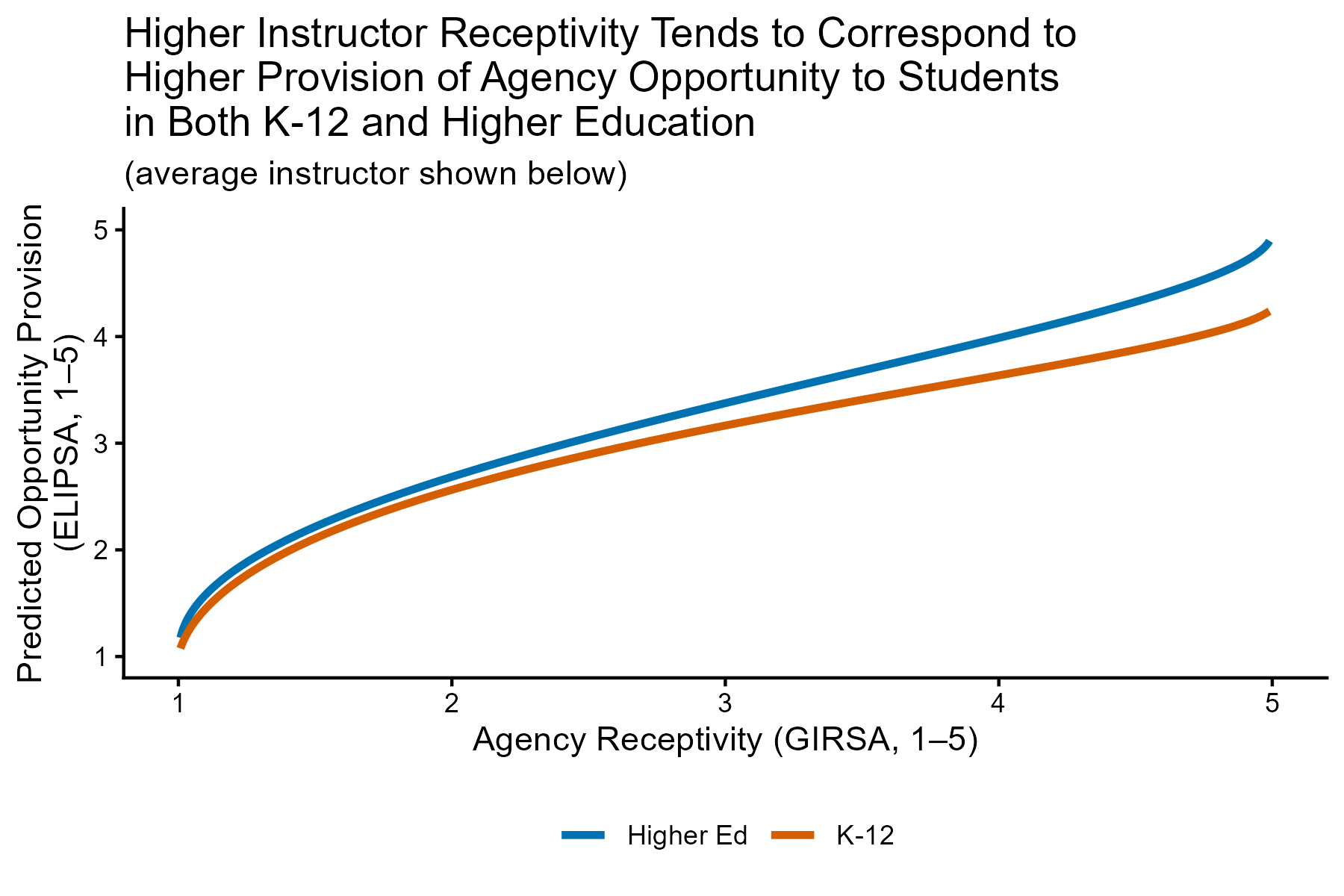
Finding 1: Receptivity strongly predicts opportunity provision—in both K–12 and higher education. Across education sectors, an instructor's openness to student agency under generally favorable circumstances—an approximation of their values about it—is the strongest single predictor of how much agency opportunity instructors actually extend to students in their classroom. This suggests that what you believe may shape what you do. This may seem obvious, but past research reviews have generally shown weaker connections between belief and action.
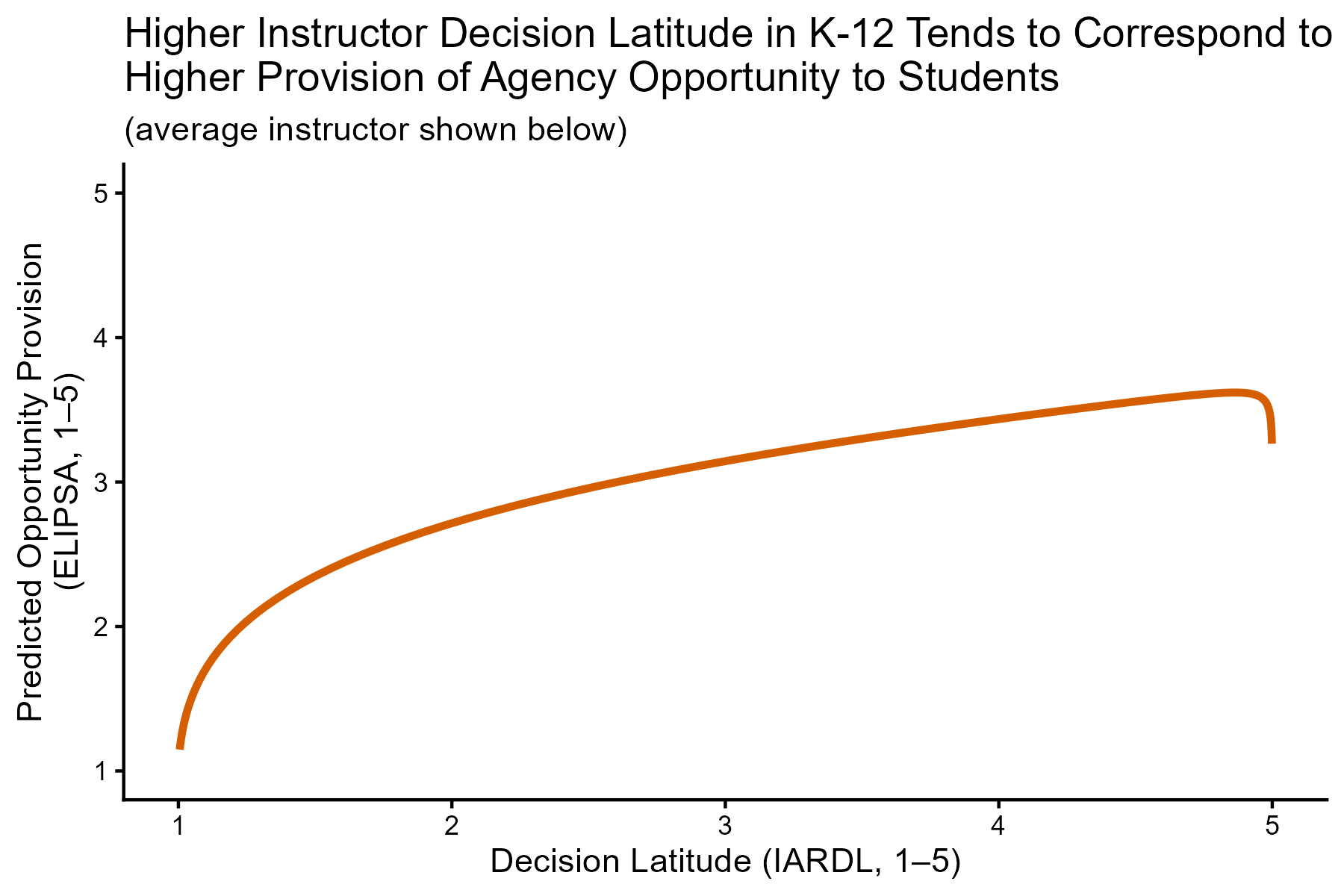
Finding 2: Decision Latitude predicts opportunity provision in K–12—but not in higher education. For K–12, the amount of authority a teacher has over decisions about pacing, assessment, grading, and required resources is a real and substantial predictor of how much agency they extend to students (more instructor decision latitude tends to correspond to more opportunity provision for students). In higher education, the relationship vanishes. Academic freedom and professorial autonomy mean that higher-education instructors are largely not constrained by the curricular and instructional bindings K–12 teachers face, so latitude is not an apparent bottleneck on what they offer students. To my knowledge, this is the first quantitative cross-sector evidence of the pattern.
What this lets us do
Beyond the relational findings, the practical value of the three-scale framework is that, taken together, it lets an educator, school leader, or researcher identify possible reasons why student agency is missing or low in a given course. For example: is it missing because the lead instructor does not value it (low Receptivity)? Because the instructor would value it but does not have authority to enable it (low Decision Latitude)? Or because the instructor has both the values and the authority but is not currently extending the opportunity in practice (low Opportunity Provision despite higher Receptivity and Decision Latitude)? That diagnostic distinction matters greatly for what kind of support or intervention will actually help.
What this means for you
For educators
Use these constructs to reflect—ideally with peers—on coursework you teach. Where are your students actually being offered agency opportunity in their learning? Where do you find yourself holding back, and why? Distinguishing between what you value, what you have control over, and what you currently do is the most actionable move; once those three things are separated, you can better identify the one or two feasible shifts that would actually move opportunity provision in your classroom.
For school or higher-education leaders
If you want instructors to extend more agency to students, you likely cannot rely on training alone. The receptivity–opportunity provision link is too strong to ignore attending to instructor values and attitudinal orientation. I further hypothesize that this link depends on providing instructors with reasonable time, resources, and encouragement.
For K–12 leaders specifically: The decisions you have made—about pacing, assessment, required resources, technology policies, and which deviations require permission—set the structural ceiling on what your teachers can do. Reflecting honestly on which of those policies impact outcomes you actually care about is a worthwhile use of leadership time.
For researchers
The scales are designed for formative, reflective, and research use—not for rating, ranking, or punishing educators or schools. While the validity evidence is generally supportive in this study, I do not recommend high-stakes individual use of any measure that has not been tested across a wide range of contexts and directly corroborated by related evidence. The scales are designed to support better conversations and more honest measurement in research-practice partnerships, longitudinal studies of school improvement, and evaluations of interventions aimed at shifting the conditions of student agency. I welcome inquiries from researchers interested in using or extending the instruments.
Important limitations
A few honest caveats:
Correlation does not imply causation. The findings show positive associations among the three instructor characteristics. The study cannot establish that any one of them causes the others. Designing interventions that move Receptivity or Decision Latitude experimentally is the natural next step for this.
These measures capture some of the general conditions related to student agency, but they are not sufficient to measure the entire student agency environment. They focus on the instructor's perspective on the classroom and the course. The institution, the school system, the community, and the students themselves are all part of the broader environment of agency and are not directly captured here.
The data are instructor self-report, gathered through a single survey. Pairing instructor reports with additional measures—student perceptions of the same classroom and (low-stakes) observations—is the most important next study and one of my immediate priorities.
The Prolific sample is not nationally representative. External-validity arguments should be made conservatively. I am planning replication in samples drawn through different recruitment channels.
What's next
I am working toward three priorities:
- Research-practice partnerships with school systems and higher-education programs willing to use the scales formatively and to study what it takes to actually shift the conditions of student agency for students whose schools have not historically extended much of it.
- Student-facing scales—most notably for matched comparison to Opportunity Provision (ELIPSA)—so students' voice on their own school learning becomes directly comparable to what their instructors report. In development.
- Replication in samples drawn through different recruitment channels, with a particular focus on samples that pair instructor and student data and that include longitudinal classroom observation.
If you are an educator, school leader, or researcher interested in piloting these scales in your context, please contact me via the contact form at the National Center for Student Agency.